
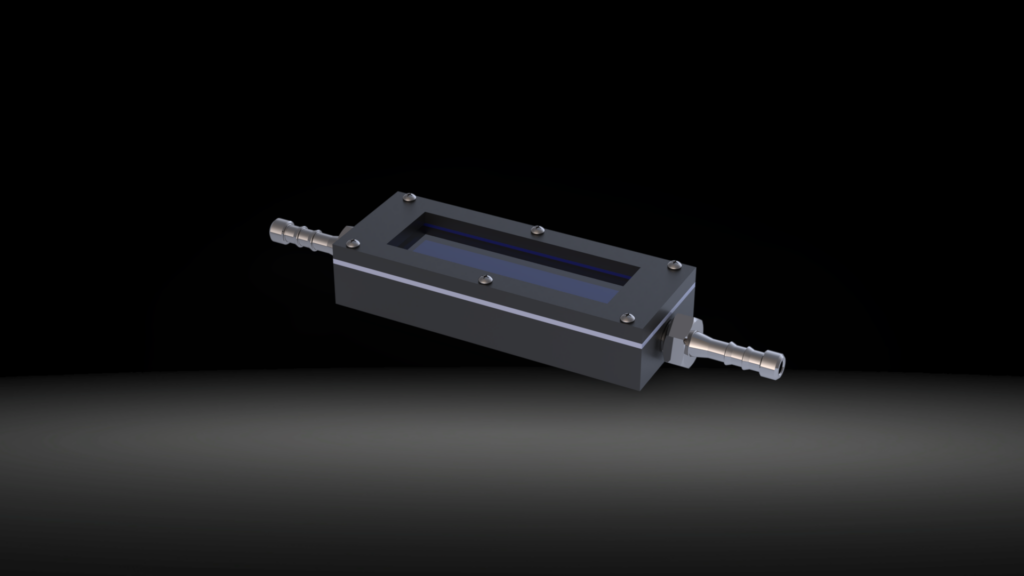
Here’s a small project I did for for a UMass Lowell Dept. of Chemistry professor. It’s a flow-through cell (liquid or gases) with a UV transparent window. Inside, the researcher places a standard microscope slide with some photo-active material on it that reacts with whatever is flowed through the cell. Chemical reactions are driven by exposure to the UV light. Kind of cool.
Made completely in-house. The body is printed in PETG, fittings in 316 stainless with a PTFE gasket under the cover. Some tapped holes, but no inserts.
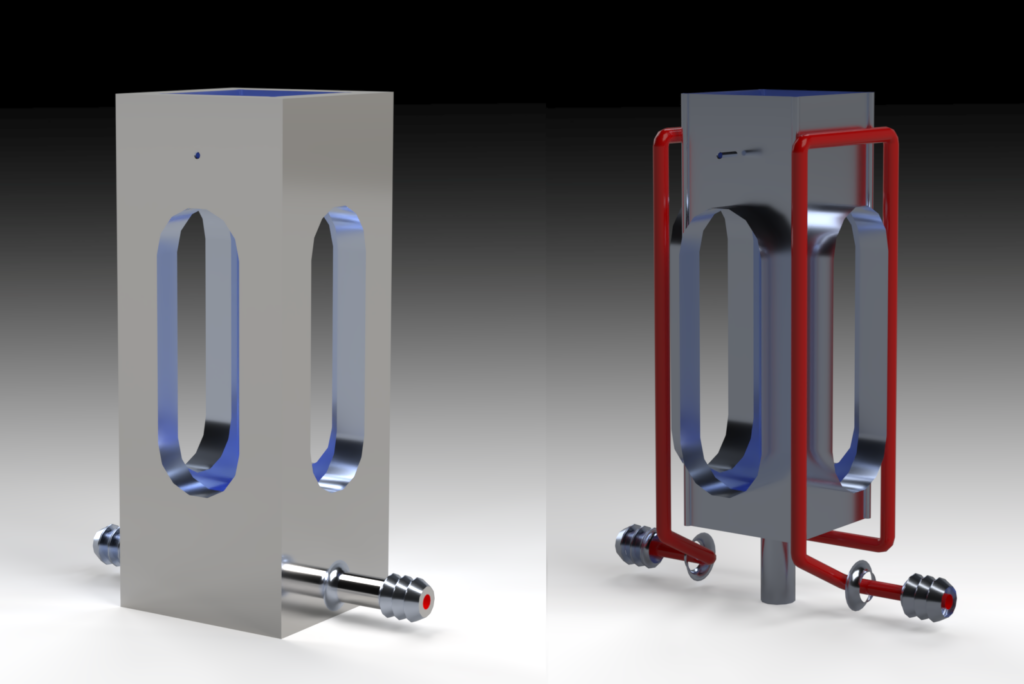
Here’s another small project for UMass Lowell’s Chemistry Department. It’s an all-metal cuvette holder with internal passages to allow a coolant to flow through. Hose connections were integrally printed. The idea is to control the temperature of a liquid sample in a quartz cuvette. It’s fabricated using AlSi10Mg Direct Metal Laser Sintering (AM) sent to a 3rd party for printing.Bijou Works LLC worked closely with the chemist/client to establish requirements and did all the Solidworks CAD, project management, working with the vendor, etc.
Below, on the left, you can see the finished cuvette holder, on the right is an “X-ray” view showing the internal passage in red.
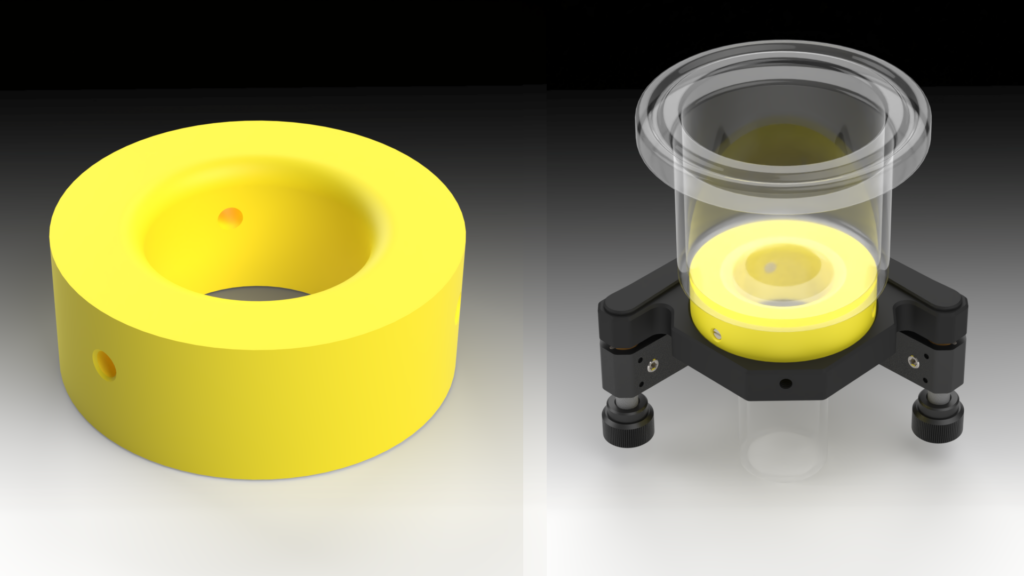
Sometimes it’s pretty simple. Here’s a 3D printed part in PETG I made for a researcher at Tufts, a physical chemist working with LN2 in a laser lab. She needed a spacer/insulator to hold a glass cell on a Thorlabs KM200 2″ mirror mount. The idea is to insulate the mirror mount from the very low temperature of the glass cell. Designed in Solidworks, sliced with PrusaSlicer, printed on a Prusa MINI+.
On left, below, is the spacer ring and on the right is the ring assembled on the KM200 with the glass cell in place so you can see how it was used.
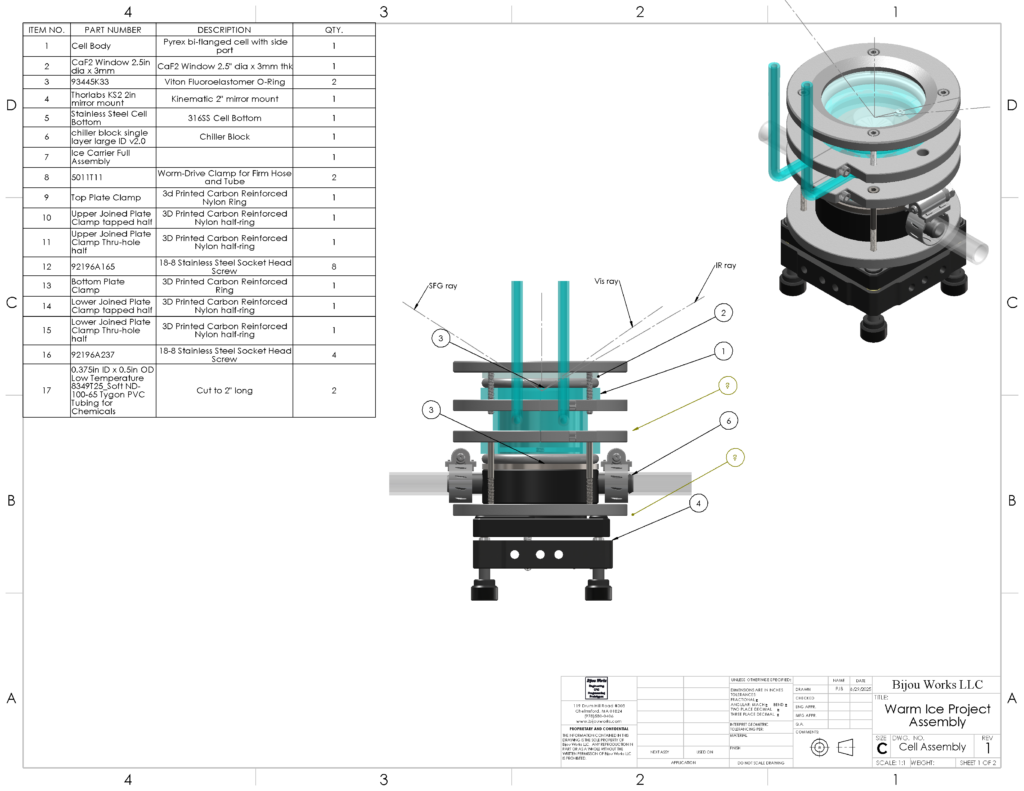
The Warm Ice Project. Something a little more complicated. Again for Tufts Chemistry, this optical cell conditions ice at about -20C. These researchers normally work at liquid Nitrogen temperatures (-196C), hence this is ‘warm’ ice.
It includes 3D printed parts using carbon reinforced plastics. In one case for strength and for another, for better thermal conductivity. At the base of the cell is a 3D printed heat exchanger with ethylene glycol/water coolant flowing through. Inside the cell, it’s more complicated with some SS parts to support and position a small sample of single-crystal ice.
Designed with Solidworks, sliced with Prusa Slicer, printed on a Prusa MINI+.
Meso-Fluidics? Is that a thing?
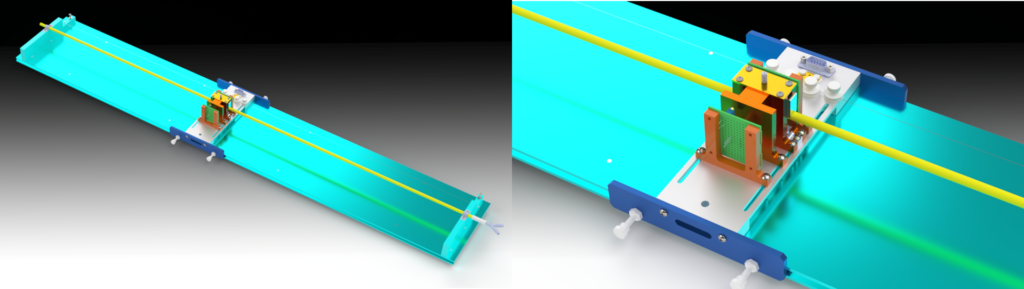
The whole 4′ long instrument, left. Closeup of the moving photometer, right. The quartz reaction tube is rendered in yellow to aid seeing.
Well, here’s a instrument I designed and built for a UMASS Lowell Physical chemist way back in about 2004. It’s still in use in the physical chemistry classroom. Designed using Solidworks, user interface in LabVIEW, some EE stuff, some optics, some spectroscopy. Kind of a fun project.
I called this instrument a ‘Continuous Flow Moving Photometer’. It’s used to study moderately fast (i.e. ~1s to completion) chemical reactions. It incorporates many principals from the science of micro-fluidics, but at a ‘meso’ scale. The flow channel is about 4mm diameter. But that’s small enough to demonstrate many microfluidics principles.
You can read more about it here:
Bisson, P.; Whitten, J. E. Studying Fast Reactions: Construction and Use of a Low-Cost Continuous-Flow Instrument. J. Chem. Educ. 2006, 83 (12), 1860–1863. https://doi.org/10.1021/ed083p1860.
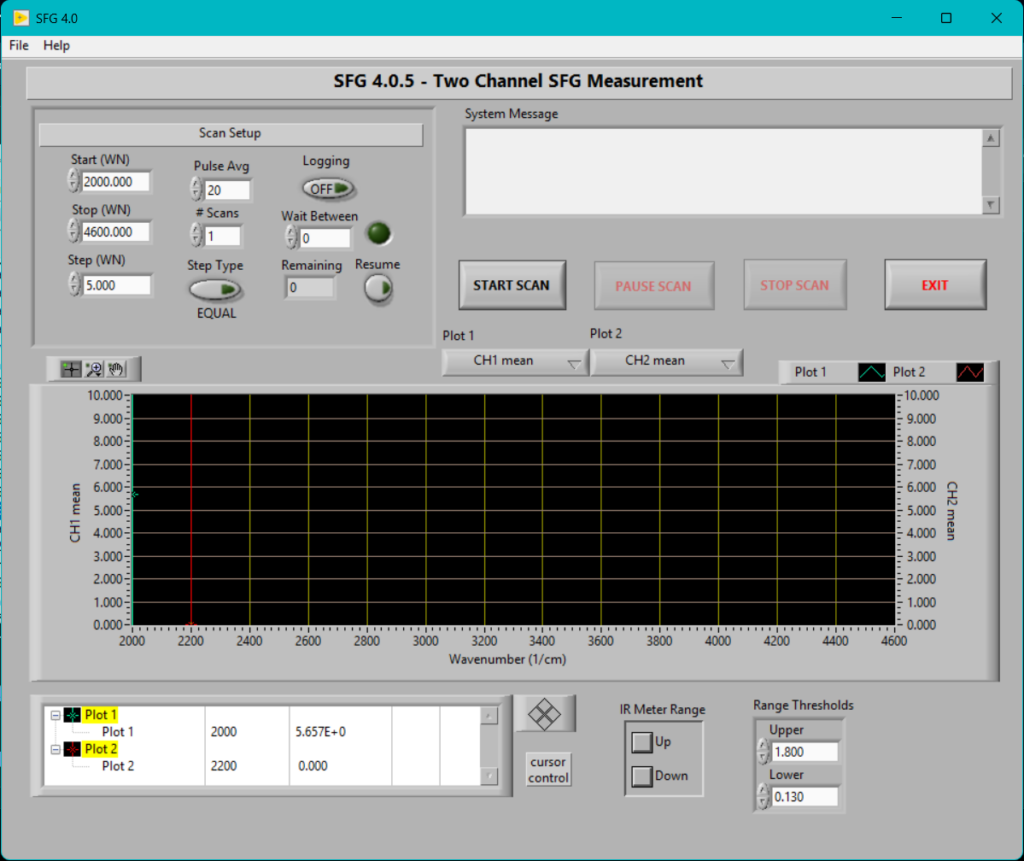
Without a UI, it’s just a pile of parts on the bench.
Most instruments also have a UI. LabVIEW is a very good development system for such a thing. It can acquire data, process it and issue commands and control to sub-components in the system. Not to mention put up a good looking graphical user interface.
Here’s the front panel of a complex system I wrote for a Tufts researcher. I call it “SFG 4”. Where SFG stands for Sum Frequency Generation, a laser based spectroscopy that gives vibrational spectra of surfaces.
This system controls multiple optical and electronic instruments on a large optical bench. It acquires raw data, processes and logs it, and displays it on the UI. It has an explicitly multi-threaded architecture using a messaging system for thread command, control, data communication.
Growing Single Crystal Ice. That’s easy, right?
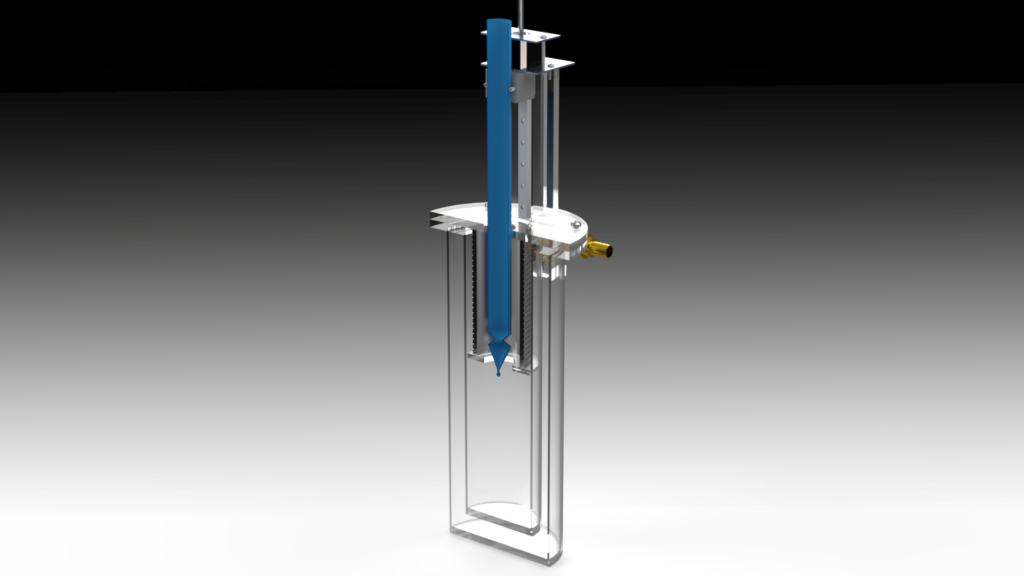
Err…nope! Back in the late 2000’s I helped develop this single crystal ice growth machine for a researcher at Tufts University. For those geeks out there, this is a Bridgeman-Stockbarger design, but upside down. That is, a seeded crucible (blue) with melt (liquid water) is pushed downward (rather than pulled upward) into a freezing zone.
The velocity of the crucible is very low, like 15cm/week. But the temperature of the freezing bath must be very tightly controlled to produce flawless single-crystal ice. Internally, a temperature gradient is set up and a temperature set point is established at a particular spot. As the crucible passes, the ice grows, one molecular layer at a time.
The temperature at that spot is controlled with a LabVIEW program that implements a PID feedback control algorithm. Typical stability is +/-2mK. You can see the machine with some of its internals in the cross section on the left below.
This machine is still in use and forms a critical part of the researcher’s ice research.
A new gas cell for a laser interferometer.
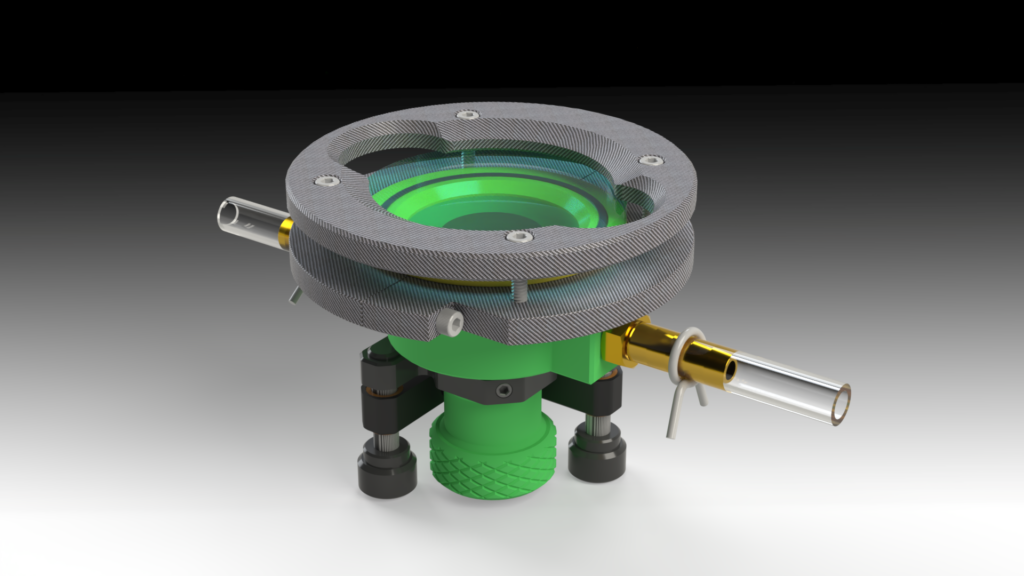
A new gas cell for an interferometer! Bijou Works LLC (well … me) just completed this new gas cell for a researcher at Tufts. This cell incorporates a printed body, COTS components, and optical devices. A window on top allows laser beams to enter and reflect off a test surface inside. Gas ports allow flow through of vapors that will interact with that same surface. The information retrieved is similar to an FTIR spectrum, but fully complex, with a real an imaginary part.
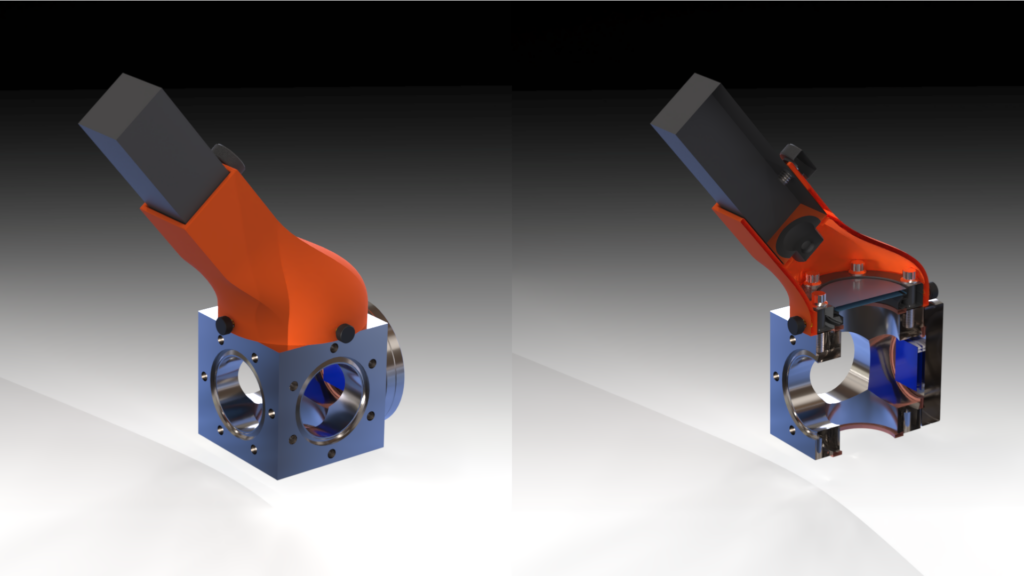
Here’s something Bijou Works LLC (err … me) recently made for a surface scientist at UMASS Lowell. It’s a small mount to adapt a laser module to a viewport on a UHV system. It’s mostly printed, but it incorporates some heat set thread inserts and some other COTS hardware. It holds the laser module at an angle to allow the beam to pass through the viewport and strike a Molybdenum (Mo) foil target on a back wall inside.
In the renderings below, the mount is seen in orange, the laser module is that black object at the top. The mount is sitting on a standard 2 3/4″ UHV 6-port cube. It grips the viewport flange with those thumb screws. On the right, a cross section reveals the viewport on the top of the cube and the Mo foil target inside.
I had fun designing this part. I used Solidworks 2025 and a loft to make the basic shape. Printed using a Prusa MINI+ in PETG.
Finally, thanks Kurt J. Lesker Company, for the CAD files of the UHV parts.
So, here’s a small project that does a good job demonstrating Bijou Works LLC capabilities.
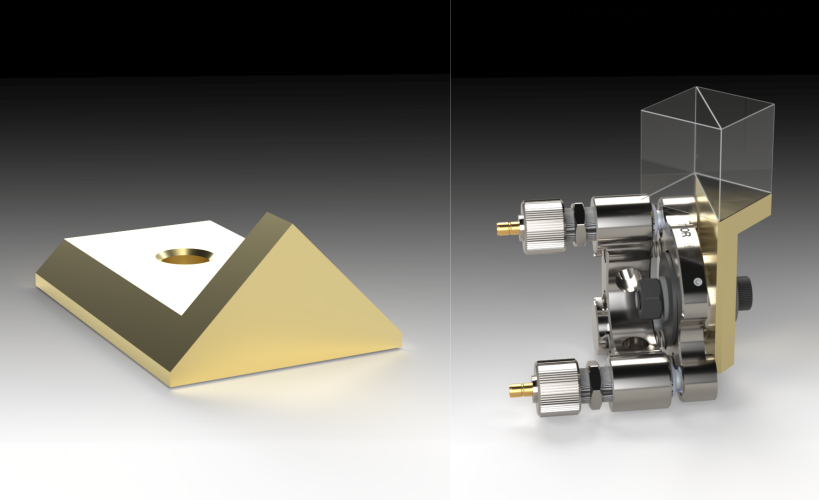
Collaboration: A research chemist at Tufts University who works a lot with interferometers asked me to make a mounting adapter for a cube type beam splitter fitted to a Thorlabs Polaris kinematic optical mount. Four identical mounts were needed. Bijou Works LLC generated several different design approaches using SOLIDWORKS and interacted with the researcher about the design using the free software eDrawings to review and verify the design goals had been met.
Engineering & Design: The splitter cube is made of two prisms glued back to back, forming a cube. A mount was designed so that it was glued to just one of the two prism halves. The mount itself (left: in gold color) is machined from Kovar (ASTM F15), which matches the thermal expansion coefficient of glass. Bijou Works LLC produced 3D STEP models and 2D machine drawings of the final design using SolidWorks 3D CAD. The Kovar/glass assembly was then bolted to the optical mount in such a way as to not distort or put undue strain on its mechanical structure. (right, gold colored in the assembly)
Fabrication: Kovar can be difficult to machine and is a specialty alloy. Most machine shops cannot handle it or have no experience. Bijou Works LLC searched for and found a local machine shop with experience with Kovar, but they didn’t have appropriate stock on hand. So Bijou Works LLC again searched for and found a small quantity supplier of Kovar, purchased some, and shipped the material to the machine shop for final fabrication.
Project Management: Though a small project in a sense, like most projects, events must be planned and coordinated. Bijou Works LLC uses professional project management and scheduling software to perform this vital function.
Professional Business dealing: Bijou Works LLC is a certified vendor for Tufts University. A normal B2B business cycle for them comprises: RFQ from the client; quote generation; purchase order from the client; invoice submission; product ship and delivery; invoice clearance (payment). Other clients may have different business cycles.
If you are a researcher or some other small organization, and you have a requirement for a one-off prototype, but lack the engineering and design talent in house, consider contacting Bijou Works LLC (sales@bijouworks.com). Please visit/follow our company page on Linkedin: (https://www.linkedin.com/company/bijou-works-llc), or visit our corporate website (https://bijouworks.com) to learn more and view a portfolio of projects.